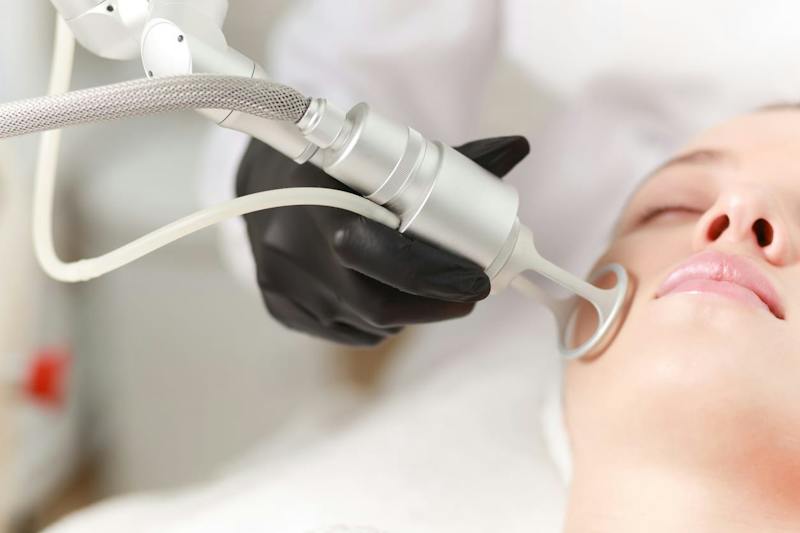
CO2 laser resurfacing uses a focused beam of light to remove damaged outer layers of skin and trigger the body to build fresh collagen. It is one of the few treatments that improves sun damage, fine wrinkles, uneven texture and certain scars in a single session. For patients across San Diego and North County, where decades of sun exposure leave their mark, it is a well-established option. Dr. Amir Moradi, MD, MBA, double board certified in facial plastic surgery and otolaryngology-head and neck surgery, offers CO2 laser resurfacing at his Vista practice.
How CO2 laser resurfacing works
The CO2 laser delivers energy that vaporizes a precise amount of skin water, which removes the damaged surface. The heat also reaches the deeper layer (the dermis, where collagen lives) and signals your skin to produce new collagen as it heals.
Most treatments today are fractional. Instead of treating every millimeter of skin, the laser creates thousands of tiny columns of treated skin and leaves healthy tissue between them. That untouched skin speeds healing and lowers risk compared with older full-field approaches. Treatment depth can be adjusted, so a lighter session and a deeper session are quite different experiences.
What CO2 laser resurfacing treats
- Sun damage, brown spots and rough texture
- Fine lines and wrinkles, especially around the mouth and eyes
- Acne scars and some surgical scars
- Loose-feeling, crepey skin on the face
It does not lift sagging tissue. If your main concern is jowls or a heavy neck, laser improves the skin on the surface but does not reposition what is underneath. That is a job for surgery, and the two are often paired in a planned sequence.
Is CO2 laser right for you? Candidacy in Vista and San Diego
Good candidates have skin concerns that sit on the surface: lines, spots, texture, scarring. You should be willing to protect your skin from the sun for weeks afterward, which matters in a county with this much sunshine.
Skin tone matters. Deeper skin tones carry a higher risk of pigment changes after aggressive laser treatment, so settings and candidacy need careful judgment. A history of cold sores near the treatment area calls for preventive medication. Recent isotretinoin use, active skin infection, and certain scarring tendencies are reasons to wait or choose a different approach.
Preparation matters. Your skin may be primed in the weeks beforehand with a simple regimen, and you will be asked to avoid tanning and to stop certain products. Plan for a few quiet days at home afterward, and arrange help if the treatment includes the eyelids, since swelling can make it hard to see clearly for a short time.
How Dr. Moradi approaches CO2 laser
Dr. Moradi treats resurfacing as a medical procedure, not a spa add-on. Settings are chosen for your skin, your concerns and how much downtime you can accept. A lighter pass with a shorter recovery may fit one patient, while a deeper treatment with more visible change suits another who can step away from social plans for longer. Because he is a surgeon, he can also plan laser alongside eyelid surgery, a brow lift or a facelift when that makes sense, and sequence them so each procedure is done safely.
What recovery looks like
Expect your skin to look sunburned and feel tight for the first days. Swelling is common, especially around the eyes. Over the first week, treated skin may ooze slightly, then crust, then flake away as new skin forms underneath.
A typical timeline for a fractional treatment looks like this. Most patients are comfortable in public with makeup after about two weeks. Pink or red skin can persist for several weeks to a few months, fading gradually. Collagen continues to build for months afterward, so results keep improving.
During healing, you will follow a gentle skincare routine, keep the skin moisturized, and avoid sun exposure. Daily broad-spectrum sunscreen becomes non-negotiable. Skipping it risks pigment problems that can undo your result.
What results to expect
Most patients see smoother, more even skin with softer fine lines and a clearer tone. Deep folds respond partially. Scars generally improve rather than disappear. Individual results vary based on your skin, the depth of treatment and how well you follow aftercare.
Frequently asked questions
Does CO2 laser resurfacing hurt? Treatment is done with numbing and, for deeper sessions, additional sedation, so you should be comfortable. Afterward, the skin feels hot and tight, similar to a bad sunburn, for a few days.
How many sessions will I need? Many patients see a clear change after one treatment. Lighter, more frequent sessions are an alternative if you prefer less downtime per visit.
How long do the results last? New collagen is lasting, but your skin keeps aging and sun exposure will cause new damage. Sun protection and good skincare decide how long you keep the improvement.
Can I combine laser with other procedures? Often yes, but timing matters. Resurfacing skin that has just been lifted can affect healing, so your surgeon will tell you when to schedule each step.
If you're considering CO2 laser resurfacing, the next step is a consultation with Dr. Moradi to look at your skin and talk through the right depth for you. Book a consultation.