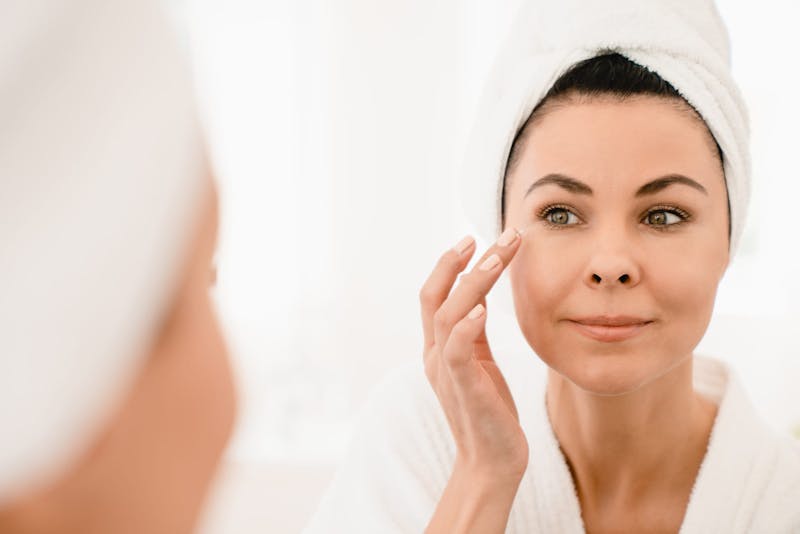
Patients rarely arrive using the words "tear trough deformity." What they say is that concealer used to work and now it does not. That it sits in the groove and makes things look worse by the afternoon. That people keep asking whether they slept badly.
The anatomy behind that complaint is specific, and it is worth understanding before anyone suggests a treatment for it.
What the tear trough actually is
Run a finger from the inner corner of your eye down and outward along the bone. That groove is the tear trough.It exists because of a ligament. The tear trough ligament, part of the orbicularis retaining ligament system, tethers the skin directly to the bone of the orbital rim. It is a fixed anchor point, and it does not move.
That single fact explains almost everything that follows. Tissue above the ligament and tissue below the ligament can both change with age. The ligament itself stays put. So as the areas on either side shift, the tethered line between them becomes a visible trench.
Some people have a pronounced tear trough at twenty five. It is inherited, and it has nothing to do with aging or lifestyle.
Why it deepens over time
Three separate processes converge on this one small area.
The first is orbital fat. The fat that cushions the eye is held back by a thin membrane called the orbital septum. As that membrane weakens, the fat pushes forward and creates a bulge that sits above the tear trough ligament. This is the "bag."
The second is midface descent and volume loss. The cheek fat that once sat high and full against the lower lid drifts downward and thins. That removes the support just below the ligament.
Put those two together and you get what surgeons call a double convexity: a bulge, then a groove, then the cheek. Light catches the bulge and falls into the groove. The shadow is what you actually see in the mirror.
The third is bone. The orbital opening genuinely widens with age as the skeleton remodels. The frame around the eye enlarges while the soft tissue inside it does not, which deepens the recess further.
Add thin lower eyelid skin, some of the thinnest on the body, and there is very little margin to hide any of it.
Hollows and dark circles are not the same problem
This is the distinction that matters most, because it determines whether any treatment will help you. Dark under eyes come from three different sources, and patients often have more than one. Shadow is structural. There is a hollow, light cannot reach into it, and the darkness is simply the absence of light. Adding volume to the hollow addresses this directly.
Pigment is melanin in the skin itself. It is more common in patients with deeper skin tones, it can be genetic, and it can follow inflammation from eczema or persistent rubbing. Filling a hollow does nothing for pigment. This responds to topical treatment, sun protection, and sometimes resurfacing.
Vascular darkness is the blue and purple cast of veins and pooled blood showing through skin that has become too thin to conceal them. Adding a small amount of volume can help by increasing the distance between the vessels and the surface, but the effect is partial.
A quick self check: tilt your chin up toward a light source. If the darkness lightens noticeably, it is largely shadow. If it stays put, pigment or vascular factors are doing most of the work.
Why the assessment matters more than the product
The under eye has become one of the most heavily marketed treatment areas in aesthetics, and most of that marketing sells a single answer to what is really several different problems.
A patient whose issue is a herniated fat pad above the ligament does not need volume added. They already have too much tissue in one place and too little in another. Injecting filler into the hollow below a bulge can deepen the contrast rather than soften it.
A patient with genuine volume loss and no bulge is often an excellent candidate for a conservative filler treatment.
A patient with pigment and mild hollowing may improve more from a skin protocol than from anything injected.
Getting this wrong is common, and it is expensive in a way that goes beyond the fee, because some of it is difficult to undo.
What happens in a consultation
Dr. Moradi examines the lower lid rather than the photograph of it. He assesses skin quality and thickness, checks whether orbital fat is protruding when you look upward, tests lower lid tone and support, looks at midface volume, and identifies how much of the darkness is shadow versus pigment.
He is double board certified in facial plastic surgery and otolaryngology, head and neck surgery. The orbit and the periorbital region sit squarely inside that training rather than at the edge of it. From that exam comes a recommendation, and sometimes the recommendation is to do less than you expected or nothing at all.
You can read more about eyelid and under eye treatment options at moradimd.com. If concealer has stopped doing its job and you would like to understand why, our Vista office is happy to take a look. Call (760) 726-6451 whenever it suits you.